
3D-Printed AFOs: What the Research Shows
A plain review of the published evidence on 3D-printed ankle-foot orthoses, for orthotists, O&P practices and clinics weighing a digital workflow.
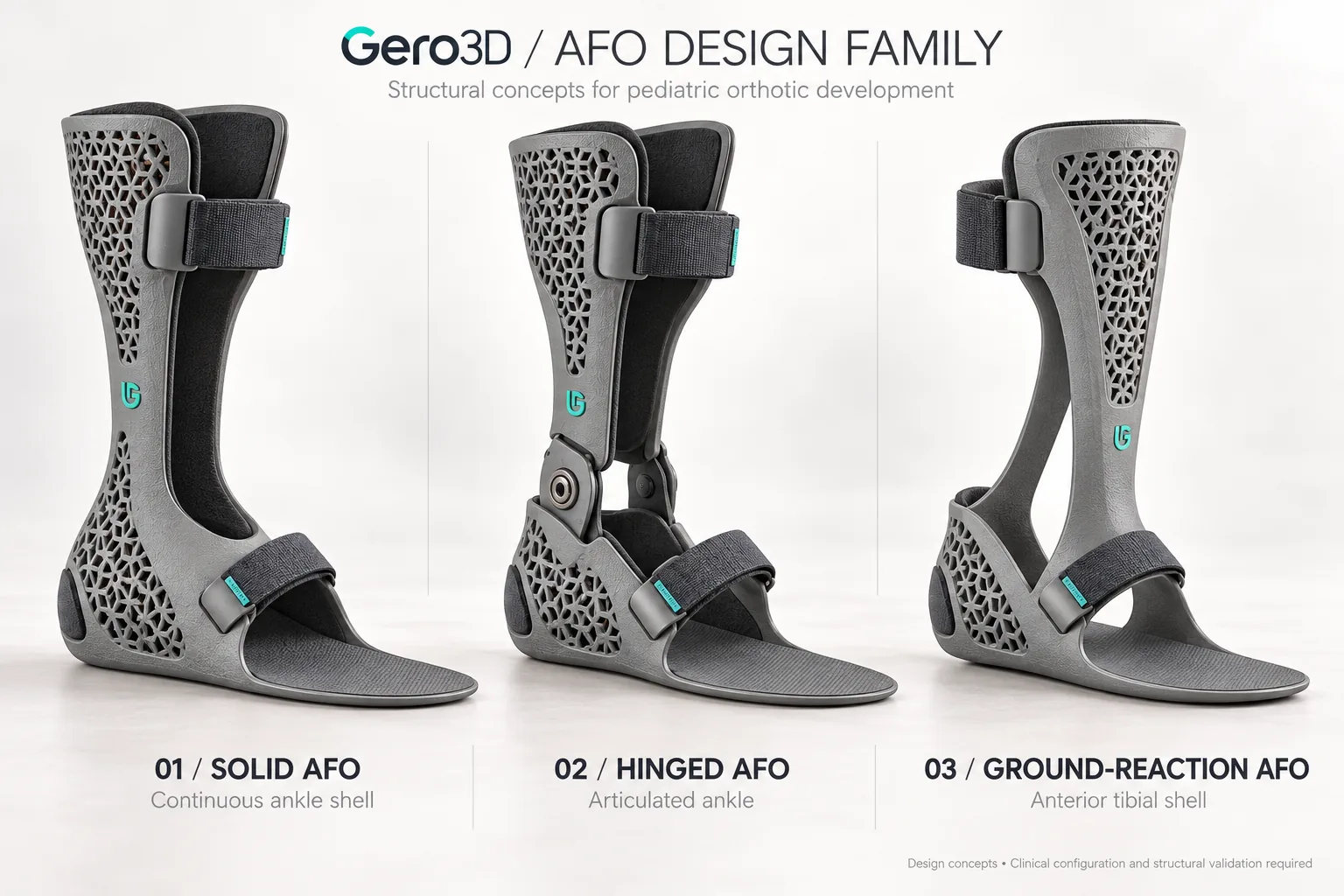
Gero3D AFO design concepts in development. They are not yet available, and clinical configuration and structural validation are still required.
Key points
- Across three systematic reviews, 3D-printed AFOs performed comparably to traditionally made AFOs on walking measures such as speed and step length.1,2,3
- Patient satisfaction with 3D-printed AFOs was similar or higher than with traditional AFOs, especially for fit, comfort and weight.2,3
- 3D scanning of the foot and lower leg was generally faster than plaster casting, with acceptable accuracy for key measurements in several studies.4,5,6
- The evidence is still early: every study in the most recent review had fewer than 12 participants, and durability depends heavily on material and design.2,7
What is a 3D-printed AFO?
An ankle-foot orthosis (AFO) supports the ankle and foot. It is commonly prescribed for foot drop, bony foot deformities and poor balance, for example after a stroke or in cerebral palsy or Charcot-Marie-Tooth disease.1,3 Traditional custom AFOs are made by hand: the orthotist takes a plaster cast, modifies the positive mold, and vacuum-forms thermoplastic over it. That process is labour-intensive, offers limited design options and can mean long waits.1
A 3D-printed AFO replaces those manual steps with a digital chain: capture the limb's shape with a scanner, design the orthosis in CAD software, and print it.
How the digital workflow works
- Scan. A systematic review found 3D scanning took about 2–11 minutes compared with 11–16 minutes for casting, though study quality was low to moderate.4 In children prescribed AFOs, both a high-cost and a low-cost scanner captured key landmarks with accuracy comparable to plaster casting, and the fastest protocol took about 26 seconds.5 Low-cost limb scanning also gave valid, reliable measurements under standardized conditions.6
- Check the ankle region. A 2026 study comparing direct scans with orthotist plaster casts found the two were not fully interchangeable. The ankle was the most consistently discrepant region (mean difference about 3.5 mm), so the authors recommend local quality control there, not only whole-limb agreement.8
- Design. A scoping review of 73 studies found wide variation in CAD methods, and that orthotic-specific CAD software was generally faster than general-purpose CAD.9
- Print and fit. Recent studies use fused deposition modelling more often than selective laser sintering, and Nylon 12 is the most tested material.2
What the outcome studies found
Gait. The first systematic review (11 studies, 1 to 8 participants each) found 3D-printed custom AFOs comparable to traditional custom and prefabricated AFOs on temporal-spatial gait parameters.1 Its 2025 update (28 papers) found walking speed and step length were mostly improved with 3D-printed AFOs compared with other AFOs and with shoes or barefoot only.2 A separate review of 10 studies found 3D-printed AFOs had similar functional efficacy to conventional AFOs.3
Weight and redesign. In 12 children with Charcot-Marie-Tooth disease, 3D-printed replicas of their traditional AFOs performed comparably on all outcomes. Redesigned 3D-printed AFOs were about 35% lighter on average and normalised the ankle dorsiflexor moment in loading response compared with shoes only and traditional AFOs.10
Satisfaction. Satisfaction scores were similar or higher with 3D-printed AFOs than with traditional AFOs, with fit and comfort rated higher in one review.2,3
Safety. A 2026 review of 17 studies and the US FDA MAUDE adverse-event database reported that no serious adverse events were identified.11 A broader review of 62 studies across orthosis types reached similar conclusions on fit and comfort, while noting small samples and durability concerns.12
Limits and open questions
- Small, early studies. All studies in the 2025 review had fewer than 12 participants, and the authors call for longitudinal trials, condition-specific studies and testing at home.2
- Printed material behaves differently. One study measured 11% porosity in PLA and 16% in Nylon parts printed at 100% fill, which reduced their effective stiffness to about one-third and one-twelfth of solid material. Designs need to be simulated and tested with real printed properties.7
- Failures happen. In a published case report, a two-material prototype AFO met clinical requirements but fractured at the ankle after a few hours of use.13
- No stiffness standard yet. There is still no agreed method for matching AFO stiffness to a patient's degree of impairment.14
What this means for an O&P practice
The research supports 3D printing as a credible way to make custom AFOs that perform on par with traditional devices, with room for lighter, redesigned forms. It does not yet show that printed AFOs are better for any particular condition. For a practice evaluating a digital workflow, the useful questions are practical ones:
- Has the scanning protocol been checked against your own casts, especially at the ankle?
- Has the design been mechanically tested with the actual printed material and settings?
- Who reviews each design before printing, and how are adjustments handled at fitting?
- How will you follow up on fit, skin and wear over the life of the device?
Where Gero3D fits
Gero3D's platform helps clinics scan, design and print custom casts and splints, with automated design and a production network behind it. We are developing a service for orthotics and prosthetics practices that applies the same scan-to-print workflow to orthoses. If you run an O&P practice and want to hear about it, get in touch.
This article summarises published research for healthcare professionals. It is not medical advice, and individual results vary. The choice of orthosis should be made by a qualified clinician.
Frequently asked questions
What is a 3D-printed AFO?
An ankle-foot orthosis made by additive manufacturing instead of thermoplastic vacuum forming. The patient's lower leg is captured with a 3D scanner (or a plaster cast is scanned), the orthosis is designed in CAD software, and the device is printed, most often in Nylon 12 or a similar polymer.
Do 3D-printed AFOs work as well as traditional AFOs?
In published studies so far, 3D-printed AFOs have performed comparably to traditionally made AFOs on walking measures such as speed and step length, and patient satisfaction has been similar or higher. The studies are small (fewer than 12 participants each in the most recent systematic review), so the evidence is still early.
Is 3D scanning as accurate as plaster casting for AFOs?
Several studies found that clinical-grade and some low-cost scanners captured key foot, ankle and lower-leg measurements within an acceptable range of plaster casting, and faster. One 2026 study found the ankle region was the least consistent between scan and cast, so local quality checks around the ankle are recommended.
Are 3D-printed AFOs durable?
Durability depends heavily on material, print settings and design. Printed parts can be more porous and less stiff than solid material, and at least one published case reported an ankle fracture of a prototype. Validated designs, mechanical testing and follow-up are important before routine use.
Does Gero3D make 3D-printed AFOs?
Gero3D's platform currently serves clinics with custom 3D-printed casts and splints. We are developing a service for orthotics and prosthetics practices, including lower-limb orthoses. Contact us if you'd like to hear about it as it becomes available.
References
- Wojciechowski E, et al. Feasibility of designing, manufacturing and delivering 3D printed ankle-foot orthoses: a systematic review. J Foot Ankle Res. 2019;12:11. doi:10.1186/s13047-019-0321-6
- Wang JZ, et al. Feasibility of designing, manufacturing and delivering 3D printed ankle-foot orthoses: an updated systematic review. J Foot Ankle Res. 2025;18(4):e70097. doi:10.1002/jfa2.70097
- Pollen TN, et al. Effects of 3D-printed ankle-foot orthoses on gait: a systematic review. Assist Technol. 2025;37(4):287–303. doi:10.1080/10400435.2024.2411563
- Farhan M, et al. Comparison of 3D scanning versus traditional methods of capturing foot and ankle morphology for the fabrication of orthoses: a systematic review. J Foot Ankle Res. 2021;14(1):2. doi:10.1186/s13047-020-00442-8
- Farhan M, et al. Comparison of accuracy and speed between plaster casting, high-cost and low-cost 3D scanners to capture foot, ankle and lower leg morphology of children requiring ankle-foot orthoses. J Foot Ankle Res. 2024;17(3):e70006. doi:10.1002/jfa2.70006
- Powers OA, Palmer JR, Wilken JM. Reliability and validity of 3D limb scanning for ankle-foot orthosis fitting. Prosthet Orthot Int. 2022;46(1):84–90. doi:10.1097/PXR.0000000000000066
- Optimizing 3D printed ankle-foot orthoses for patients with stroke: importance of effective elastic modulus and finite element simulation. Heliyon. 2024;10:e26926. doi:10.1016/j.heliyon.2024.e26926
- Peng C, et al. Comparison of direct 3D scans and plaster casts in digital ankle-foot orthosis workflows. Med Sci (Basel). 2026;14(5):589. doi:10.3390/medsci14050589
- Wang JZ, Telfer S, Burns J, Cheng TL. Computer-aided design methods for digitizing the foot and ankle orthoses manufacturing workflow: a scoping review. Prosthet Orthot Int. 2025. doi:10.1097/PXR.0000000000000496
- Wojciechowski E, et al. Replicating and redesigning ankle-foot orthoses with 3D printing for children with Charcot-Marie-Tooth disease. Gait Posture. 2022;96:73–80. doi:10.1016/j.gaitpost.2022.05.006
- Kasianenko et al. Clinical evaluation of custom-made 3D-printed ankle-foot orthoses: effectiveness, safety, and clinical implications. Wiad Lek. 2026;79(6):1364–1371. doi:10.36740/WLek/222568
- Atallah et al. The current state of 3D-printed orthoses clinical outcomes: a systematic review. BMC Musculoskelet Disord. 2025;26(1):822. doi:10.1186/s12891-025-09070-4
- Pereira HR, et al. Multidisciplinary co-creation, design and clinical evaluation of a two-material 3D printed ankle-foot orthosis: a case report of fibular hemimelia. Assist Technol. 2025. doi:10.1080/10400435.2025.2570273
- Rogati G, Caravaggi P, Leardini A. Design principles, manufacturing and evaluation techniques of custom dynamic ankle-foot orthoses: a review study. J Foot Ankle Res. 2022;15(1):38. doi:10.1186/s13047-022-00547-2
Sources retrieved from PubMed.